Introduction
Growing a business is exciting—but scaling it successfully is a different challenge.
As a company grows, so does everything around it: leads, customers, data, sales activities, marketing campaigns, customer queries, follow-ups, and internal processes. Managing all of this manually can quickly become inefficient and expensive.
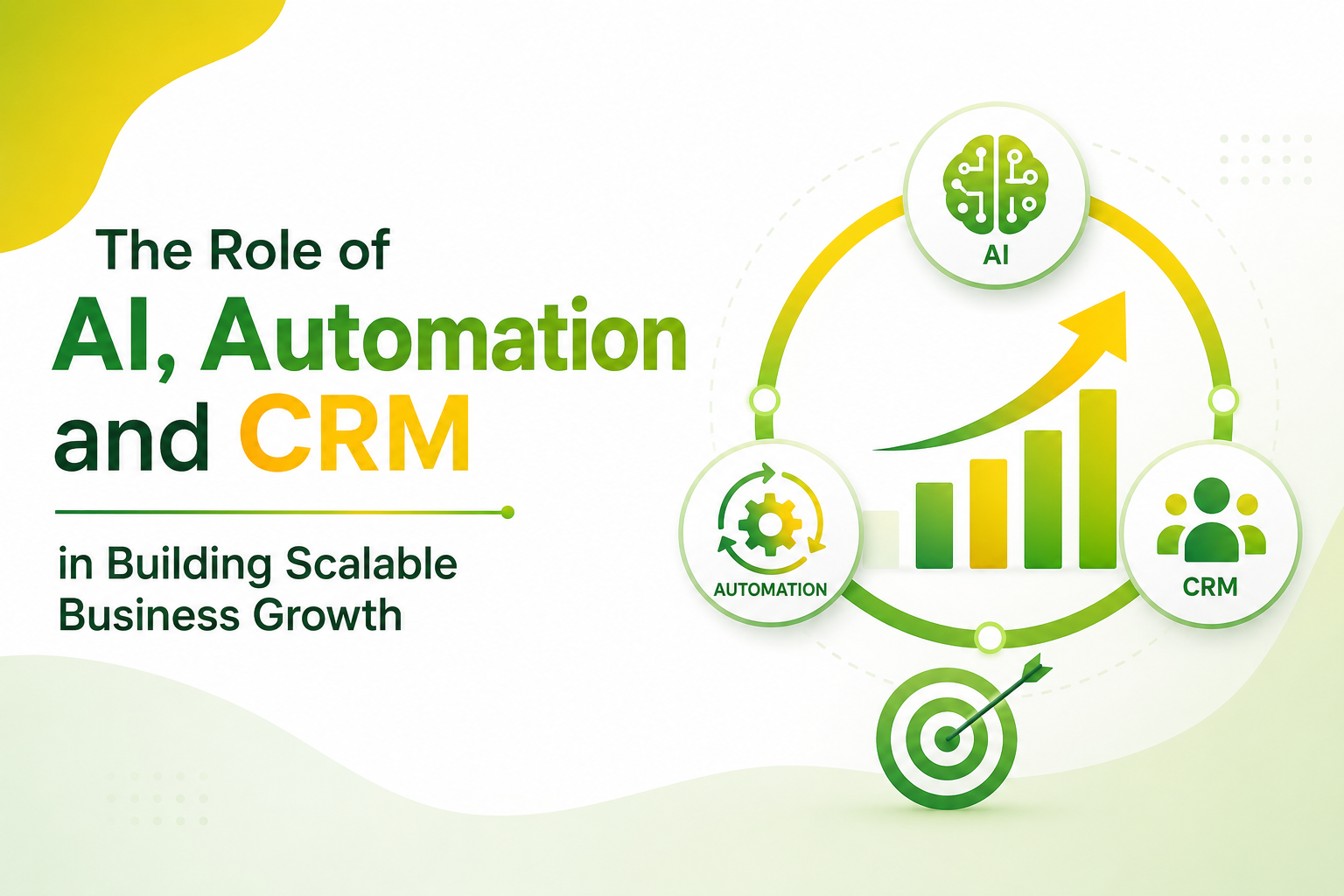
This is where Artificial Intelligence (AI), automation, and Customer Relationship Management (CRM) systems can make a significant difference.
AI helps businesses make smarter decisions and deliver more personalized experiences. Automation reduces repetitive manual work and improves operational efficiency. CRM systems bring customer and sales information together, helping teams manage relationships and opportunities more effectively.
When these three technologies work together, businesses can create a scalable growth system that is faster, more efficient, and easier to manage.
What Does Scalable Business Growth Really Mean?
Scalable growth means increasing revenue and customer volume without increasing costs and operational complexity at the same rate.
For example, imagine a company receives 100 leads every month. Its sales team may be able to manually follow up with these leads.
But what happens when the business starts receiving 1,000 or 5,000 leads?
Hiring more people for every increase in leads may not be the most efficient approach.
A scalable business uses technology to handle repetitive processes, organize customer data, prioritize opportunities, and help employees focus on higher-value activities.
This is where AI, automation, and CRM become powerful growth enablers.
How AI Supports Business Growth
AI is changing how businesses analyze information, communicate with customers, and make decisions.
Instead of simply collecting large amounts of data, businesses can use AI to identify patterns and generate useful insights.
1. Better Business Decision-Making
Businesses generate data from websites, social media, advertising platforms, sales activities, customer interactions, and CRM systems.
AI can analyze this information much faster than traditional manual processes.
It can help identify:
* Which marketing channels generate better leads
* Which customers are most likely to convert
* Which products are performing well
* Where customers are dropping out of the sales funnel
* Which campaigns require optimization
These insights allow businesses to make decisions based on data rather than assumptions.
2. Personalized Customer Experiences
Customers increasingly expect businesses to understand their needs.
AI can help analyze customer behavior and preferences to deliver more personalized communication.
For example, an e-commerce business can recommend products based on browsing and purchasing behavior, while a B2B company can personalize follow-up messages based on a prospect’s industry and previous interactions.
Personalization can improve engagement and help businesses build stronger customer relationships.
3. AI-Powered Lead Qualification
Not every lead has the same value.
AI can help businesses analyze leads based on factors such as:
* Customer behavior
* Engagement level
* Industry
* Company size
* Previous interactions
* Purchase intent
This allows sales teams to focus their time on prospects that are more likely to become customers.
The Importance of Automation in Scaling Operations
Automation is one of the most practical ways to improve business efficiency.
It allows companies to create predefined workflows that automatically perform repetitive tasks.
Instead of employees manually completing the same process hundreds of times, technology can handle much of the work.
### Common Business Processes That Can Be Automated
Businesses can automate tasks such as:
* Lead assignment
* Email follow-ups
* Appointment reminders
* Customer onboarding
* Marketing campaigns
* Sales notifications
* Data entry
* Report generation
* Customer support responses
* Internal task management
For example, when someone fills out a website form, an automated workflow can immediately add the lead to the CRM, assign it to the appropriate salesperson, send a confirmation email, and schedule a follow-up task.
This saves time while reducing the risk of leads being forgotten.
How CRM Systems Create a Centralized Growth Engine
A CRM system acts as a central location for managing customer and prospect information.
Without a CRM, customer data may be scattered across spreadsheets, emails, messaging platforms, and different software tools.
This makes it difficult for teams to understand the complete customer journey.
A CRM can bring information together, including:
* Contact details
* Lead sources
* Sales conversations
* Previous purchases
* Customer interactions
* Follow-up activities
* Deal stages
* Customer preferences
With this information available in one place, sales and marketing teams can work more efficiently.
CRM and Sales Pipeline Management
A CRM can help businesses visualize where prospects are within the sales funnel.
For example:
New Lead → Qualified Lead → Meeting Scheduled → Proposal Sent → Negotiation → Won/Lost
This visibility helps sales teams understand which opportunities need attention.
It also helps business leaders identify bottlenecks in the sales process.
AI + Automation + CRM: A Powerful Combination
AI, automation, and CRM are valuable individually—but their real potential appears when they work together.
Think of them as three parts of the same growth system.
CRM = Customer Data
Automation = Process Efficiency
AI = Intelligence and Insights
For example, consider a company that generates leads through digital advertising.
Step 1: Lead Generation
A potential customer submits a form through the company’s website.
Step 2: CRM Capture
The lead is automatically added to the CRM with relevant information.
Step 3: Automated Follow-Up
The system sends an immediate confirmation message and creates a follow-up task for the sales team.
Step 4: AI Lead Scoring
AI evaluates the lead based on available information and engagement behavior.
Step 5: Sales Prioritization
High-intent leads are prioritized for immediate sales follow-up.
Step 6: Automated Nurturing
Leads that are not ready to purchase can enter an automated nurturing sequence.
Step 7: Performance Analysis
CRM and AI-powered reporting can help the business identify which sources, campaigns, and customer segments are generating the best results.
This creates a connected growth process instead of a collection of disconnected activities.
Why Businesses Need This Approach in 2026
The modern customer journey is no longer linear.
A customer might discover a business through social media, visit its website, read reviews, download content, interact with an advertisement, speak with a salesperson, and return weeks later before making a purchase.
Businesses need systems that can manage these multiple touchpoints.
AI, automation, and CRM can help companies create a more connected customer journey while reducing manual work.
The goal is not simply to use more technology.
The goal is to use technology **strategically.
Benefits of AI, Automation and CRM for Businesses
1. Increased Productivity
Automation reduces repetitive administrative work, allowing employees to focus on strategy, creativity, sales, and customer relationships.
2. Faster Lead Response
Automated workflows can respond to new leads immediately instead of waiting for manual follow-up.
3. Better Customer Retention
CRM systems help businesses maintain customer information and track interactions, making it easier to provide consistent experiences.
4. Improved Sales Efficiency
AI-powered insights and CRM data can help sales teams prioritize the right opportunities.
5. Reduced Operational Costs
Automation can reduce the amount of time employees spend on repetitive processes.
6. Data-Driven Marketing
Businesses can use customer and campaign data to understand what is working and where improvements are needed.
7. Easier Scaling
When processes are standardized and automated, businesses can handle increasing customer and lead volumes without completely rebuilding their operations.
Common Mistakes Businesses Make
Technology alone does not guarantee growth.
Businesses often make the mistake of implementing tools without first understanding their processes.
Choosing Too Many Tools
Using multiple disconnected platforms can create more complexity instead of reducing it.
Automating Broken Processes
Automation cannot fix an inefficient process.
Businesses should first identify and improve the process before automating it.
Ignoring Data Quality
AI and CRM systems depend heavily on accurate information.
Duplicate, incomplete, or outdated customer data can reduce the effectiveness of automation and AI-driven insights.
Removing the Human Element
AI can support employees, but it should not eliminate meaningful human interaction where customers need it.
The strongest systems combine technology with human expertise.
How to Build a Scalable Technology Strategy
Businesses don’t need to automate everything on day one.
A better approach is to start with high-impact areas.
Step 1: Identify Repetitive Tasks
Find activities that consume significant employee time but do not require complex decision-making.
Step 2: Map the Customer Journey
Understand how a prospect moves from first interaction to purchase and beyond.
Step 3: Centralize Customer Data
Use a CRM to create a reliable source of customer and prospect information.
Step 4: Automate High-Impact Workflows
Start with processes such as lead capture, follow-ups, notifications, and customer onboarding.
Step 5: Introduce AI Where It Adds Value
Use AI for areas such as lead scoring, customer insights, personalization, forecasting, and content assistance.
Step 6: Measure Performance
Track metrics such as:
* Lead response time
* Conversion rate
* Customer acquisition cost
* Sales cycle length
* Customer retention
* Revenue per customer
* Marketing ROI
Step 7: Continuously Optimize
Technology should evolve alongside the business. Review workflows regularly and improve them based on actual performance data.
The Future of Scalable Business Growth
The future of business growth will not simply belong to companies that use the most technology.
It will belong to companies that use technology effectively.
AI can provide intelligence. Automation can provide efficiency. CRM can provide visibility.
Together, they can help businesses create a connected infrastructure where marketing, sales, operations, and customer service work toward the same growth objectives.
However, technology should support—not replace—strategy.
Businesses still need strong positioning, valuable products or services, effective marketing, skilled teams, and meaningful customer relationships.
Technology simply allows those strengths to operate at a much greater scale.
Conclusion
Building a scalable business requires more than generating additional leads or increasing sales.
It requires creating systems that can support growth without creating unnecessary complexity.
**AI, automation, and CRM can become the foundation of that system.
AI helps businesses understand data and make smarter decisions. Automation improves efficiency and ensures important processes happen consistently. CRM systems organize customer information and provide visibility across the sales journey.
When these technologies are strategically integrated, businesses can respond faster, operate more efficiently, deliver better customer experiences, and scale with greater confidence.
The real advantage isn’t simply adopting AI, automation, or CRM.
It’s building a connected system where all three work together to turn business activity into sustainable growth.
Google Ads
High-Performance Website & WordPress Development Solutions
A website is often the first interaction a potential customer has with your business. But in a competitive digital landscape, simply having a website is