How D2C and B2B Brands Can Build a Predictable Growth Engine with Performance Marketing
Growth is no longer about simply generating more traffic, impressions or leads. For D2C and B2B brands, sustainable growth depends on building a marketing system that can consistently attract the right audience, convert them into customers and improve results over time.This is where performance marketing plays a critical role.Unlike traditional marketing approaches that often focus on visibility and brand awareness, performance marketing connects marketing activity with measurable business outcomes. Brands can track clicks, leads, conversions, customer acquisition costs, revenue and return on ad spend to understand what is working and where improvements are needed.
For D2C and B2B businesses, the goal should not simply be to run successful campaigns. The real objective is to build a predictable growth engine that can be measured, optimised and scaled.
- What Is a Predictable Growth Engine?
A predictable growth engine is a connected marketing system where businesses can understand how their investment translates into leads, customers and revenue.
Instead of relying on occasional campaign successes, brands create repeatable processes for:
* Reaching the right target audience
* Generating qualified traffic
* Capturing leads or purchases
* Converting prospects
* Measuring customer acquisition costs
* Improving conversion rates
* Retaining customers
* Scaling successful campaigns
The more data a business collects, the better it can understand which channels, audiences, messages and offers generate profitable results.
Performance marketing provides the framework needed to create this system.Why Performance Marketing Matters for D2C and B2B Brands
Although D2C and B2B businesses have different customer journeys, both need measurable and efficient marketing.
D2C brands
D2C brands usually sell directly to consumers through ecommerce websites or online platforms. Their marketing decisions can often be influenced by metrics such as:
* Cost per acquisition
* Conversion rate
* Average order value
* Customer lifetime value
* Return on ad spend
* Repeat purchase rateFor example, an ecommerce brand may use paid social advertising to attract new customers, search advertising to capture high-intent demand and remarketing campaigns to bring back visitors who did not purchase.
B2B brands
B2B businesses often have longer and more complex buying journeys. A potential customer may interact with several pieces of content, attend a webinar, request a demo and speak with a sales team before becoming a customer.
Important B2B performance marketing metrics can include:
* Cost per lead
* Cost per qualified lead
* Lead-to-opportunity rate
* Opportunity-to-customer rate
* Customer acquisition cost
* Pipeline value
* Revenue generated
* Customer lifetime valueThe key difference is the buying journey, but the principle remains the same: **marketing should be connected to measurable business outcomes.**
1. Start with Clear Business Goals
A predictable growth engine begins with clear objectives.
Businesses should avoid setting vague goals such as “increase traffic” or “get more engagement”. Instead, marketing goals should connect directly to business outcomes.
For example:
* Generate 500 qualified leads per month
* Increase ecommerce revenue by 30%
* Reduce customer acquisition cost by 15%
* Increase qualified demo bookings
* Improve repeat purchase rates
* Increase return on ad spendClear goals make it easier to decide which channels, campaigns and metrics matter.
For D2C brands, the primary goal may be profitable revenue growth. For B2B businesses, it may be qualified pipeline generation.
2. Understand the Customer Journey
Performance marketing works best when businesses understand how customers move from awareness to conversion.
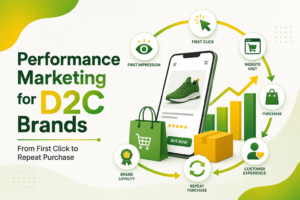
A typical journey can include:
**Awareness → Consideration → Conversion → Retention → Advocacy**
At the awareness stage, potential customers may discover a brand through social media, search engines, video content or other advertising channels.
During consideration, they may compare products, read reviews, visit the website or download resources.
At the conversion stage, they may make a purchase, submit a form, request a demo or contact sales.
After conversion, retention strategies can encourage repeat purchases, renewals, upgrades or referrals.
Each stage requires different messaging and campaigns.
3. Build a Strong Acquisition Strategy
A predictable growth engine needs reliable sources of qualified traffic.
Depending on the business model, brands can combine:
* Google Ads
* Meta Ads
* LinkedIn Ads
* SEO
* Content marketing
* Remarketing
* Email marketing
* Affiliate marketing
* Influencer marketingThe right mix depends on the audience and buying journey.
For example, a D2C brand may find strong results through Meta and Google Ads, while a B2B technology company may benefit from LinkedIn Ads, Google Search, SEO and content marketing.
The objective is not to be everywhere. It is to identify the channels that can consistently generate profitable customers.
4. Create Landing Pages That Convert
Driving traffic is only one part of performance marketing.
If visitors arrive on a poorly designed or confusing website, advertising performance can suffer.
Landing pages should have:
* A clear value proposition
* Strong and relevant headlines
* Easy navigation
* Relevant messaging
* Social proof
* Clear calls to action
* Fast loading times
* Mobile-friendly design
* Simple forms or checkout processesThe landing page should also match the advertising message.
For example, if an advertisement promotes a specific service, the landing page should immediately explain that service rather than sending visitors to a generic homepage.
This alignment can improve conversion rates and make paid traffic more efficient.
# 5. Use Data to Make Better Marketing Decisions
One of the biggest advantages of performance marketing is the amount of data it provides.
Instead of guessing which campaigns are successful, businesses can analyse performance based on real results.
However, businesses should avoid focusing on individual metrics in isolation.
A campaign can generate inexpensive clicks but very few customers. Another campaign may have a higher cost per click but generate significantly more revenue.
The ultimate goal is to understand **which marketing activities contribute to profitable growth.
- 6. Connect Marketing with CRM and Sales Data
This is particularly important for B2B brands.
Advertising platforms may tell you how many leads a campaign generated, but that does not necessarily tell you whether those leads became valuable customers.
Connecting marketing platforms with a CRM can provide a clearer picture.
For example:
Ad → Landing Page → Lead → Qualified Lead → Opportunity → Customer → Revenue**
This allows businesses to understand which campaigns are generating actual revenue rather than simply generating form submissions.
The same principle can benefit D2C brands by connecting advertising data with ecommerce and customer data.
7. Automate Repetitive Marketing Processes
Automation can make a growth engine more scalable.
Businesses can automate tasks such as:
* Lead follow-ups
* Email sequences
* Customer segmentation
* Retargeting audiences
* CRM updates
* Reporting
* Campaign alerts
* Customer onboarding
* Repeat purchase campaignsFor B2B businesses, automation can help nurture leads until they are ready to speak with sales.
For D2C brands, automated email and remarketing campaigns can encourage customers to return, purchase complementary products or reorder.
Automation does not replace strategy. Instead, it allows marketing teams to spend more time on strategy, testing and optimisation.
8. Test and Optimise Continuously
A predictable growth engine is never completely finished.
Customer behaviour changes. Competitors change their offers. Advertising costs fluctuate. Platforms update their algorithms.
This makes continuous experimentation essential.
Brands can test:
* Headlines
* Ad creatives
* Offers
* Audiences
* Landing pages
* Calls to action
* Email messaging
* Pricing
* Content formatsFor example, a D2C brand could test two different product creatives to identify which generates more purchases.
A B2B company could test different landing page headlines to determine which generates more qualified demo requests.
The important part is to test one meaningful variable at a time and use reliable data to decide what should be scaled.
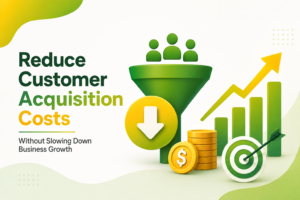
9. Improve Customer Acquisition Cost
Scaling revenue without controlling acquisition costs can create an unhealthy growth model.
Businesses should continuously look for ways to improve customer acquisition efficiency.
This can include:
* Improving ad relevance
* Increasing conversion rates
* Optimising landing pages
* Targeting higher-intent audiences
* Improving lead quality
* Retargeting existing visitors
* Increasing average order value
* Improving customer retention
* Building organic traffic through SEOFor D2C brands, increasing average order value and repeat purchases can make paid acquisition more profitable.
For B2B businesses, improving lead qualification and sales conversion rates can reduce the effective cost of acquiring customers.
10. Build a Full-Funnel Marketing Strategy
A predictable growth engine should not depend on a single campaign or channel.
Instead, businesses should create a connected full-funnel strategy.
Top of the Funnel
Focus on reaching new audiences through:
* Social advertising
* Video
* SEO content
* Educational content
* Display advertisingMiddle of the Funnel
Focus on building consideration through:
* Case studies
* Guides
* Product comparisons
* Webinars
* Email nurturing
* RemarketingBottom of the Funnel
Focus on conversions through:
* Search advertising
* Product campaigns
* Demo campaigns
* Retargeting
* Promotional offers
* Conversion-focused landing pagesRetention
Continue generating value through:
* Email marketing
* Loyalty programmes
* Personalised offers
* Cross-selling
* Upselling
* Customer support
* Repeat purchase campaignsThis approach allows brands to optimise the entire customer journey rather than focusing only on acquisition.
# The Role of SEO in a Predictable Growth Engine
Paid advertising can generate immediate traffic, but SEO can create a long-term source of organic demand.
A strong growth strategy can combine paid and organic channels.
For example, paid search can help a brand capture demand for high-intent keywords immediately, while SEO can gradually build visibility for relevant informational and commercial searches.
Content can also support performance campaigns by answering customer questions, addressing objections and building trust. The combination of SEO + paid media + conversion optimisation can create a stronger and more sustainable acquisition system.
Why Technology Matters
Technology is the infrastructure behind a scalable marketing engine.
Businesses may need to connect:
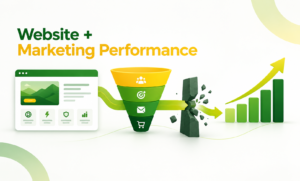
**Website + Analytics + Advertising Platforms + CRM + Ecommerce + Email + Automation**
When these systems work together, businesses can collect better data and make faster decisions.
Technology can also help with:
* Lead tracking
* Customer segmentation
* Marketing attribution
* Automated reporting
* Personalisation
* Campaign management
* Conversion trackingWithout reliable tracking and technology infrastructure, it becomes difficult to understand what is actually driving growth.
How to Build Your Performance Marketing Growth Engine
A practical framework can be broken into six stages:
Stage 1: Strategy
Define your audience, business goals, positioning and KPIs.
Stage 2: Acquisition
Select the channels most likely to reach your target customers.
Stage 3: Conversion
Optimise your website, landing pages and offers.
Stage 4: Measurement
Track leads, customers, revenue and acquisition costs.
Stage 5: Optimisation
Use data to improve campaigns, creatives, audiences and conversion rates.
Stage 6: Scaling
Increase investment in campaigns and channels that consistently produce profitable results.
This creates a repeatable process rather than relying on individual marketing campaigns.
Common Mistakes That Prevent Predictable Growth
Several mistakes can make performance marketing less effective.
Focusing only on traffic
More visitors do not automatically mean more revenue. Businesses need to focus on qualified traffic and conversions.
Measuring vanity metrics
Impressions and clicks are useful, but they should ultimately connect to leads, customers and revenue.
Ignoring the website
Poor landing pages can waste otherwise effective advertising budgets.
### Scaling too quickly
Increasing ad spend before understanding campaign economics can increase costs without improving profitability.
Using the same strategy for every audience
D2C and B2B customers have different buying behaviours, so campaigns should reflect their individual journeys.
Not tracking the complete funnel
If businesses only measure leads or purchases without understanding what happens afterwards, they may optimise towards the wrong outcomes.
Final Thoughts
A predictable growth engine does not come from simply spending more money on advertising.
It comes from creating a connected system where **strategy, performance marketing, SEO, technology, data, conversion optimisation and customer retention** work together.
For D2C brands, this can mean turning paid traffic into profitable purchases and repeat customers.
For B2B brands, it can mean turning advertising and content into qualified leads, sales opportunities and long-term revenue.
The businesses that build this system successfully can make better decisions about where to invest, what to optimise and when to scale.
Ultimately, the goal of performance marketing is not just to generate more clicks or leads. It is to create a **measurable, repeatable and scalable path from marketing investment to business growth.**