Customer acquisition is one of the biggest challenges businesses face when trying to scale. Whether you are running a D2C brand, B2B company, ecommerce business, or service-based organisation, acquiring new customers requires investment in advertising, content, sales, technology and marketing.
The problem starts when Customer Acquisition Cost (CAC) continues to increase while revenue growth remains flat.
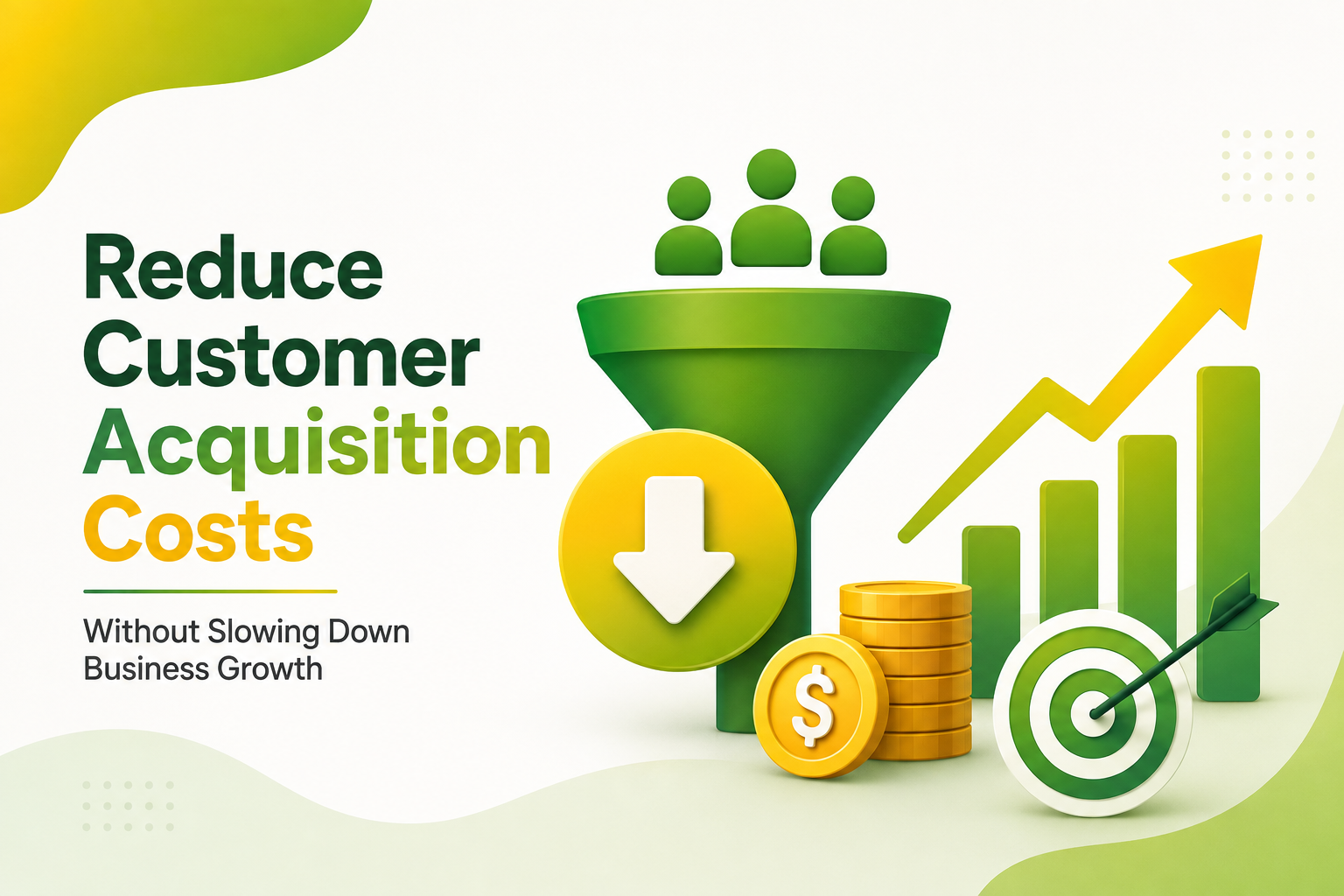
Reducing acquisition costs does not necessarily mean spending less on marketing. In many cases, the smarter approach is to make every pound of your marketing budget work harder. This means targeting the right audience, improving conversion rates, increasing customer value, reducing wasted ad spend and building a stronger customer journey.
The goal is simple: acquire more valuable customers without allowing acquisition costs to grow at the same rate as revenue.
What Is Customer Acquisition Cost?
Customer Acquisition Cost is the average amount a business spends to acquire one new customer.
A simple way to calculate CAC is:
CAC = Total Sales and Marketing Costs ÷ Number of New Customers Acquired
For example, if a company spends £10,000 on marketing and sales in a month and acquires 200 new customers:
£10,000 ÷ 200 = £50 CAC
However, CAC should not be viewed in isolation. A £50 acquisition cost could be highly profitable for a customer who generates £500 in lifetime revenue, but expensive for a customer who generates only £60.
This is why businesses should consider CAC alongside metrics such as:
Customer Lifetime Value (CLV)
* Average Order Value (AOV)
* Conversion Rate
* Cost Per Acquisition (CPA)
* Return on Ad Spend (ROAS)
* Lead-to-customer conversion rate
* Repeat purchase rate
* Customer retention rate
The objective is not simply to achieve the lowest possible CAC. It is to achieve a profitable and sustainable CAC.
Why Customer Acquisition Costs Increase as Businesses Scale
Many businesses assume that increasing the advertising budget will automatically generate more customers. In reality, scaling can create new challenges.
As you increase your marketing spend, you may:
* Exhaust your highest-performing audience segments
* Start targeting less qualified prospects
* Increase competition in paid advertising auctions
* Experience higher cost per click
* Generate more low-quality leads
* Reduce conversion rates
* Increase pressure on sales teams
* Send more traffic to poorly optimised landing pages
This can create a situation where revenue grows, but acquisition costs grow even faster.
For sustainable growth, businesses need to focus on **efficiency as well as volume.
1. Improve Your Audience Targeting
One of the fastest ways to reduce wasted marketing spend is to improve audience targeting.
Not every person who sees your advertisement is a potential customer. If your campaigns target broad audiences without considering customer needs, behaviours, purchasing power or intent, you could be paying for traffic that is unlikely to convert.
Start by defining your ideal customer.
For B2B businesses, this could include:
* Industry
* Company size
* Job role
* Location
* Business challenges
* Buying authority
* Technology used
* Purchase intent
For D2C and ecommerce brands, useful factors may include:
* Demographics
* Interests
* Shopping behaviour
* Previous purchases
* Product preferences
* Engagement
* Website activity
The better you understand your audience, the easier it becomes to spend your marketing budget on people who are more likely to convert.
2. Focus on High-Intent Traffic
Not all website traffic has the same value.
Someone searching for **”buy running shoes online” has a very different level of intent from someone searching for “how to choose running shoes.
Both searches can be valuable, but they belong to different stages of the customer journey.
3. Optimise Your Landing Pages
Driving more traffic to your website will not reduce CAC if visitors do not convert.
For example, imagine a campaign generates 10,000 visitors but only 100 people make a purchase.
Your business may be paying heavily for traffic while losing potential customers because of poor conversion performance.
Landing pages should be designed around the specific campaign and customer intent.
A strong landing page should have:
* A clear headline
* A strong value proposition
* Relevant messaging
* Simple navigation
* Trust signals
* Customer reviews or testimonials
* Clear benefits
* Strong calls to action
* Mobile-friendly design
* Fast loading speed
* A simple conversion process
The key principle is message match.
If your advertisement promotes a specific product or service, the landing page should immediately continue that message.
The more closely the ad, landing page and offer align, the greater the opportunity to improve conversion rates and reduce acquisition costs.
4. Increase Your Conversion Rate Before Increasing Ad Spend
One of the biggest mistakes businesses make is increasing their advertising budget before fixing their conversion funnel.
Suppose you spend £5,000 and generate 100 customers.
If you increase the budget to £10,000 without improving the funnel, you may simply double your costs without achieving proportional growth.
Instead, consider improving your conversion rate first.
For example:
Before optimisation
10,000 visitors → 200 customers
Conversion rate = 2%
After optimisation
10,000 visitors → 300 customers
Conversion rate = 3%
The same traffic now generates 50% more customers.
This is why Conversion Rate Optimisation (CRO) can have a major impact on CAC.
5. Stop Treating Every Marketing Channel the Same
Different marketing channels have different economics.
Google Ads may perform well for high-intent searches. Meta Ads may work better for product discovery and visual storytelling. SEO can generate long-term organic traffic. Email marketing can generate repeat purchases at a relatively low marginal cost.
Instead of spreading your budget evenly, evaluate each channel based on business outcomes.
Track:
* Spend
* Leads
* Qualified leads
* Customers
* Revenue
* CAC
* ROAS
* Customer Lifetime Value
This helps identify which channels are actually contributing to profitable growth.
A channel that generates a large number of leads may look successful until you discover that most leads never become customers.
The real question is not:
“Which channel generates the most leads?
It is:
“Which channel generates the most valuable customers at a sustainable acquisition cost?”
6. Use Retargeting to Recover Lost Opportunities
Most website visitors will not convert during their first interaction with a brand.
They may:
* Browse products
* Visit pricing pages
* Read blog posts
* Add items to their basket
* Start a form
* Compare different options
* Leave without taking action
Without retargeting, businesses may lose the opportunity to bring these users back.
Retargeting allows businesses to reconnect with people who have already interacted with their brand, subject to applicable platform rules and privacy requirements.
For example, an ecommerce brand could create separate audiences for:
* Product viewers
* Basket abandoners
* Previous customers
* Website visitors
* Engaged social media users
The messaging can then be tailored to each audience.
Someone who has already viewed a product does not necessarily need another generic brand advertisement. They may respond better to product benefits, reviews, relevant offers or additional information that helps them make a decision.
7. Increase Customer Lifetime Value
Reducing CAC is only one side of profitable growth.
The other is increasing the value generated by each customer.
If acquiring a customer costs £40 and that customer generates £50 in revenue, your growth model may be difficult to scale.
But if the same customer eventually generates £200 through repeat purchases, upgrades or additional services, the economics become much stronger.
Businesses can increase Customer Lifetime Value through:
* Repeat purchase campaigns
* Cross-selling
* Upselling
* Subscription models
* Loyalty programmes
* Personalised recommendations
* Email marketing
* Customer education
* Excellent customer service
This creates an important principle:
You do not always need to reduce CAC if you can increase the value of every acquired customer.
The strongest growth strategies work on both sides of the equation.
8. Build a Strong Retention Strategy
Acquiring a new customer is often only the beginning of the relationship.
If customers make one purchase and never return, the business must continuously spend money to replace them.
Retention can reduce pressure on acquisition by increasing revenue from the customers you have already acquired.
A strong retention strategy may include:
Personalised Email Campaigns
Send relevant product recommendations, educational content, offers and reminders based on customer behaviour.
Post-Purchase Communication
The customer journey should continue after the sale. Helpful onboarding and follow-up communication can increase satisfaction and encourage repeat purchases.
Loyalty Programmes
Reward customers for repeat purchases, referrals or engagement.
Customer Feedback
Use reviews, surveys and support conversations to identify problems and improve the overall customer experience.
Retention is particularly important for subscription businesses, ecommerce brands and companies with recurring revenue models.
9. Use First-Party Data More Effectively
As digital advertising becomes increasingly dependent on privacy-conscious data practices, businesses should build stronger relationships with their own customers and audiences.
First-party data can include information collected directly through legitimate customer interactions, such as:
* Purchase history
* Email subscriptions
* Website interactions
* Customer preferences
* CRM records
* Product interests
* Support interactions
When used responsibly and in accordance with applicable privacy requirements, this information can help businesses create more relevant campaigns and better customer experiences.
Instead of relying entirely on external targeting, businesses can use their own customer data to understand what their best customers look like and identify opportunities for more efficient acquisition.
10. Improve Your Ad Creative and Messaging
Sometimes the problem is not the audience or budget. It is the advertisement itself.
Weak creative can result in low engagement, poor click-through rates and expensive traffic.
Effective advertising should quickly communicate:
What is the product or service?
Who is it for?
What problem does it solve?
Why should someone care?
What makes the offer different?
For Meta and other visual platforms, businesses should continuously test different:
* Headlines
* Images
* Videos
* Hooks
* Offers
* Formats
* Value propositions
* Calls to action
For search advertising, focus on aligning ad copy with the user’s search intent and landing page.
Small improvements in click-through rate and conversion rate can have a significant impact when campaigns operate at scale.
11. Fix Your Conversion Tracking
You cannot reduce CAC effectively if you do not know where your customers are coming from.
Poor tracking can lead businesses to:
* Overinvest in underperforming channels
* Underinvest in profitable campaigns
* Misjudge lead quality
* Report incorrect ROAS
* Miss conversion opportunities
* Make decisions based on incomplete data
Your tracking setup should connect marketing activity with meaningful business outcomes.
For ecommerce businesses, this may include:
* Product views
* Add-to-cart events
* Checkout starts
* Purchases
* Revenue
* Average order value
For B2B businesses, tracking should go beyond form submissions and include:
* Leads
* Marketing-qualified leads
* Sales-qualified leads
* Opportunities
* Closed deals
* Revenue
The further you can connect marketing activity to actual revenue, the better your optimisation decisions become.
12. Automate Repetitive Marketing Tasks
Automation can improve marketing efficiency without requiring a larger team.
For example, businesses can automate:
* Lead nurturing
* Welcome emails
* Abandoned basket reminders
* Customer follow-ups
* Lead scoring
* CRM updates
* Reporting
* Audience segmentation
* Retention campaigns
Automation allows marketing teams to spend more time on strategy, creative testing and optimisation rather than repetitive manual work.
For B2B businesses, automated lead nurturing can also help sales teams focus on prospects who show stronger buying signals.
13. Build a Full-Funnel Customer Acquisition Strategy
A common reason CAC increases is that businesses focus too heavily on the bottom of the funnel.
They target users who are already close to making a purchase but face intense competition for those customers.
A stronger strategy considers the entire customer journey.
14. Use SEO to Reduce Long-Term Dependence on Paid Advertising
Paid advertising can deliver immediate traffic, but every click generally requires ongoing spend.
SEO works differently.
A well-optimised website can continue generating organic traffic from valuable search queries over time.
Businesses can reduce their dependence on paid acquisition by building organic visibility around:
* Product keywords
* Service keywords
* Problem-based searches
* Comparison searches
* Informational topics
* Location-based searches
* Long-tail keywords
SEO should not necessarily replace paid advertising. Instead, the two channels can complement each other.
Paid search can provide immediate visibility and valuable data, while SEO can build sustainable organic traffic over the long term.
15. Test Before You Scale
Scaling a campaign before understanding what works can quickly increase CAC.
Instead, follow a structured process:
Test → Measure → Optimise → Validate → Scale
Test different variables such as:
* Audience
* Creative
* Messaging
* Landing pages
* Offers
* Keywords
* Campaign structures
* Follow-up sequences
Once you identify a repeatable combination that generates profitable customers, gradually increase investment.
Scaling should be based on evidence rather than assumptions.
A Practical Framework for Reducing CAC
Businesses looking to reduce customer acquisition costs can use this simple framework:
Step 1: Measure
Calculate CAC by channel, campaign, product and customer segment.
Step 2: Identify Waste
Find campaigns, audiences and keywords that consume budget without generating valuable customers.
Step 3: Improve Targeting
Focus your marketing spend on audiences with stronger intent and higher potential customer value.
Step 4: Optimise Conversion
Improve landing pages, website experience, checkout processes and lead forms.
Step 5: Improve Customer Value
Increase AOV, repeat purchases, upsells and retention.
Step 6: Automate
Use CRM and marketing automation to improve efficiency and follow-up.
Step 7: Scale Gradually
Increase budgets only after identifying campaigns that can generate profitable results consistently.
CAC Reduction Is About Efficiency, Not Simply Cutting Costs
Reducing customer acquisition costs does not mean turning off your advertising campaigns or cutting your marketing budget.
In fact, aggressive budget cuts can sometimes slow business growth.
The better approach is to improve the efficiency of the entire customer acquisition system.
That means:
Better targeting + better creative + better conversion rates + better retention + better customer value = more efficient growth
For example, improving your conversion rate from 2% to 3%, increasing average order value and generating more repeat purchases can make a much larger difference than simply reducing advertising spend.
Final Thoughts
Customer acquisition costs will always be an important consideration for growing businesses, but CAC should never be viewed as just an advertising metric.
It is influenced by the entire customer journey — from targeting and advertising to website experience, conversion, sales, retention and repeat purchases.
The businesses that scale efficiently are not necessarily the ones that spend the least.
They are the ones that understand where their money is being spent, which customers generate the most value and how every stage of the funnel contributes to revenue.
By improving targeting, optimising conversion rates, using data effectively, strengthening retention, investing in SEO and automation, and scaling proven campaigns carefully, businesses can reduce unnecessary acquisition costs while continuing to grow.