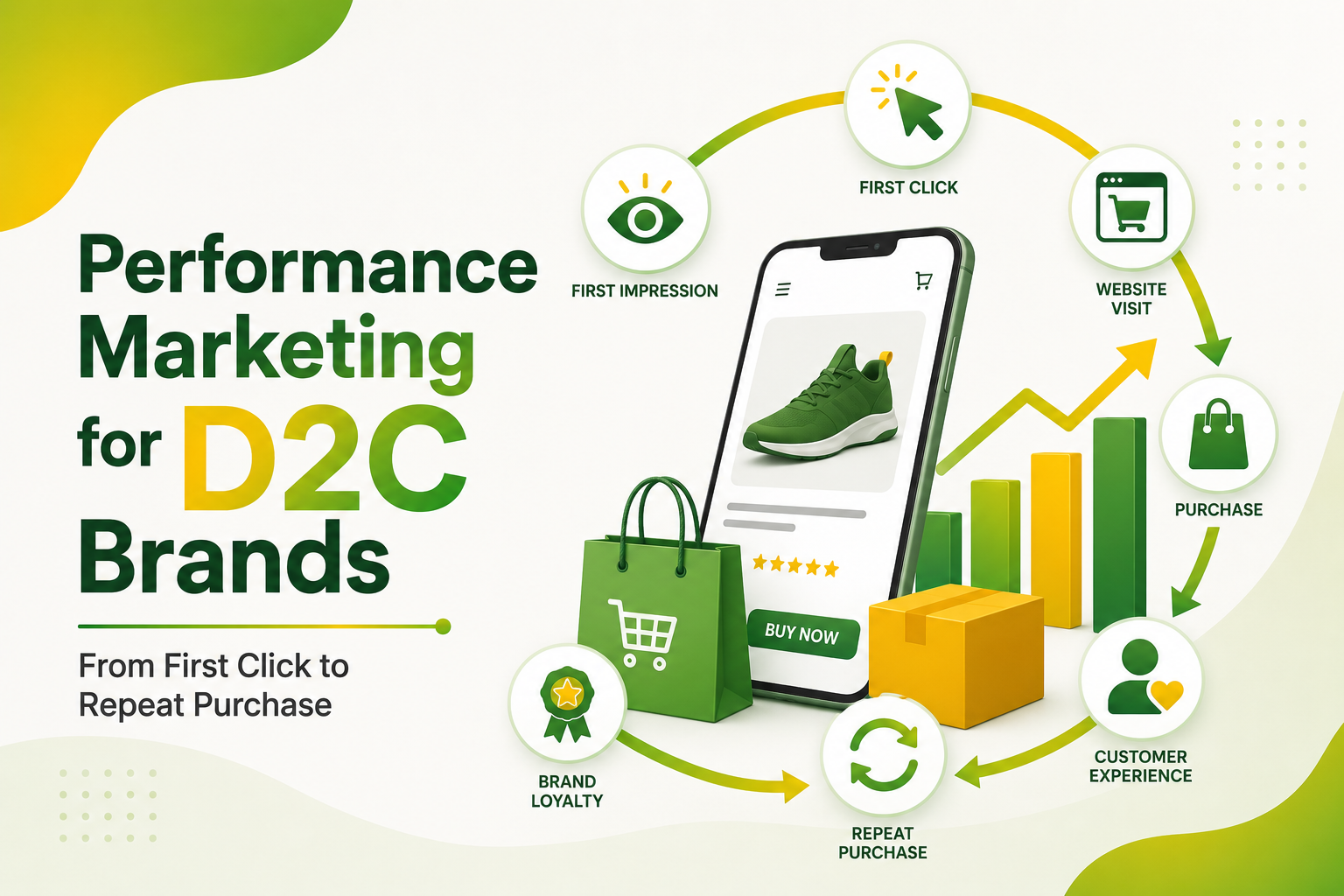
For a D2C brand, getting someone to click an advertisement is only the beginning.
The real challenge is turning that click into a customer—and then turning that customer into someone who buys again.
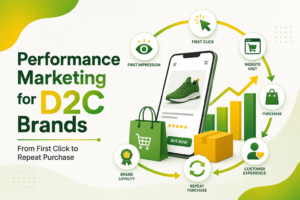
A successful performance marketing strategy for D2C brands therefore cannot focus only on clicks, impressions, or even first-time conversions. It needs to look at the entire customer journey:
First Impression → First Click → Website Visit → Purchase → Customer Experience → Repeat Purchase → Brand Loyalty
This is what makes performance marketing so powerful for direct-to-consumer businesses. Every stage can be measured, analyzed, tested, and optimized.
But the objective shouldn’t simply be to acquire more customers.
The objective is to acquire profitable customers who continue to create value for the brand.
What Is Performance Marketing for D2C Brands?
Performance marketing is a data-driven approach where marketing campaigns are optimized around measurable business outcomes.
For D2C brands, these outcomes can include:
* Website purchases
* Revenue
* Customer acquisition
* Conversion rate
* Return on ad spend (ROAS)
* Customer acquisition cost (CAC)
* Average order value (AOV)
* Repeat purchase rate
* Customer lifetime value (CLV)
Unlike traditional advertising, where success can be difficult to measure precisely, performance marketing gives D2C brands visibility into how campaigns contribute to actual business results.
For example, a D2C skincare brand can track a customer journey from an Instagram or Facebook advertisement to the product page, checkout, first purchase, and eventually a second order.
This data can then be used to improve every stage of the funnel.
Stage 1: Winning the First Click
Before a customer can purchase, they need a reason to stop scrolling.
D2C brands compete for attention across social media, search engines, video platforms, marketplaces, and other digital channels.
This makes the first stage of performance marketing incredibly important.
Create Ads That Focus on the Customer
Instead of simply saying:
“Buy Our Product.”
Strong performance creatives answer questions such as:
* What problem does the product solve?
* Why should customers care?
* What makes the product different?
* What result can customers expect?
* Why should they trust the brand?
For example, a fitness brand could focus its creative on a specific customer problem rather than simply displaying the product.
The goal is to make the customer think:
“This product is relevant to me.”
Stage 2: Getting the Right Traffic
A high number of clicks doesn’t necessarily mean a successful campaign.
A campaign generating thousands of visitors but very few purchases may have a traffic-quality problem.
D2C brands should evaluate:
* Cost per click
* Click-through rate
* Landing-page engagement
* Conversion rate
* Customer acquisition cost
* Revenue generated
* ROAS
The key question is:
Are we attracting people who are likely to buy?
A lower volume of high-intent traffic can be more valuable than a large volume of low-quality traffic.
Stage 3: Turning Visitors Into Customers
Once a customer clicks the advertisement, the website takes over.
This is where many D2C brands lose potential customers.
A great advertisement cannot compensate for a poor website experience.
Your Landing Page Needs to Continue the Ad’s Story
The message customers see in the advertisement should connect naturally with the landing page.
If an advertisement promotes:
“20% Off Your First Order”
the landing page should make that offer immediately clear.
The customer shouldn’t have to search for it.
## Important Elements of a High-Converting D2C Product Page
A strong product page should typically include:
* Clear product benefits
* High-quality product images
* Demonstration or video content where relevant
* Simple product descriptions
* Customer reviews
* Trust signals
* Pricing and offers
* Clear call-to-action
* Shipping information
* Return/refund information
* FAQs
The fewer unnecessary barriers customers encounter, the easier it becomes for them to complete their purchase.
Stage 4: Optimizing the First Purchase
Getting someone to your checkout isn’t enough.
You need to understand where customers drop off.
For example:
1,000 Ad Clicks → 700 Product Page Visits → 200 Add to Cart → 100 Checkouts → 60 Purchases
This funnel immediately raises important questions.
Why didn’t the other 940 visitors purchase?
Was the product price too high?
Was there insufficient trust?
Was shipping too expensive?
Was the checkout process complicated?
Was the offer unclear?
Performance marketing gives brands the data needed to investigate these questions.
Stage 5: Don’t Optimize Only for ROAS
ROAS is an important metric—but it shouldn’t be the only metric D2C brands consider.
Imagine two campaigns:
Campaign A
* ROAS: 5x
* Low average order value
* Low repeat purchase rate
Campaign B
* ROAS: 3.5x
* Higher average order value
* Strong repeat purchase rate
* Higher customer lifetime value
At first glance, Campaign A looks better.
But if customers acquired through Campaign B purchase repeatedly, Campaign B may create significantly more long-term revenue.
This is why D2C brands should move beyond first-purchase economics and consider Customer Lifetime Value (CLV).
Stage 6: Turning First-Time Buyers Into Repeat Customers
This is where performance marketing becomes a long-term growth engine.
Acquiring a new customer can be expensive.
Once a customer has already purchased, the brand has an opportunity to build a relationship and encourage another purchase.
Depending on the product category, repeat-purchase strategies can include:
* Email marketing
* SMS campaigns
* Product recommendations
* Replenishment reminders
* Loyalty programs
* Personalized offers
* Cross-selling
* Upselling
* Educational content
* New-product announcements
For example, if a customer purchases a 30-day skincare product, the brand can send a reminder around the expected replenishment period.
This is more effective than randomly sending promotional messages.
Stage 7: Retargeting Customers at the Right Time
Not every customer needs the same message.
A person who viewed a product but didn’t purchase should not necessarily receive the same advertisement as someone who purchased the product two months ago.
D2C brands can segment audiences based on behavior.
Example Audience Segments
Website Visitors:
Show product-focused retargeting campaigns.
Add-to-Cart Users:
Use reminders, social proof, or relevant offers.
First-Time Customers:
Focus on product education and complementary products.
Repeat Customers:
Promote loyalty benefits, new products, or exclusive offers.
High-Value Customers:
Create personalized campaigns designed to increase lifetime value.
This makes marketing more relevant and reduces wasted advertising spend.
Stage 8: Increasing Average Order Value
Performance marketing shouldn’t only focus on getting more customers.
Brands should also look at how much each customer spends.
Increasing Average Order Value (AOV) can improve the economics of customer acquisition.
D2C brands can experiment with:
* Product bundles
* Buy-more-save-more offers
* Cross-selling
* Upselling
* Free shipping thresholds
* Limited-time bundles
* Subscription options
For example:
Instead of purchasing one product for ₹999, a customer may be encouraged to purchase a bundle worth ₹1,699.
If the offer provides genuine value, both the customer and brand can benefit.
Stage 9: Creative Testing Is a Growth Lever
D2C performance marketing depends heavily on creative performance.
An advertisement that performs well today may not perform equally well forever.
Brands should continuously test:
* Hooks
* Headlines
* Visual formats
* Product demonstrations
* Customer testimonials
* UGC-style content
* Offers
* Calls-to-action
* Short-form videos
* Static creatives
* Different audience angles
The goal isn’t to create hundreds of random advertisements.
It is to identify which messages resonate with which audiences.
Once a winning concept is identified, it can be refined and scaled.
Stage 10: Use Data to Make Better Decisions
Performance marketing creates a constant feedback loop.
Launch → Measure → Analyze → Test → Optimize → Scale
Common Performance Marketing Mistakes D2C Brands Should Avoid
1. Focusing Only on ROAS
ROAS can hide the bigger picture if brands don’t consider margins, repeat purchases, and customer lifetime value.
2. Scaling Too Quickly
Increasing the advertising budget aggressively without validating campaign economics can quickly increase losses.
3. Ignoring the Website
A strong advertisement cannot fix a poor checkout or product-page experience.
4. Using the Same Creative for Too Long
Creative fatigue can reduce engagement and increase acquisition costs.
5. Treating Every Customer the Same
Different customers have different needs and purchase behaviors.
Segmentation can make marketing more relevant.
6. Ignoring Existing Customers
Businesses often spend heavily to acquire new customers while neglecting people who have already purchased.
Existing customers can represent one of the strongest opportunities for profitable growth.
A Simple Performance Marketing Framework for D2C Brands
A scalable D2C performance marketing strategy can be structured around five stages:
1. Acquire
Use paid social, search, influencer partnerships, and other relevant channels to attract qualified prospects.
2. Convert
Create strong landing pages, product pages, offers, and checkout experiences.
3. Measure
Track acquisition costs, conversion rates, revenue, ROAS, and customer behavior.
4. Retain
Use email, SMS, remarketing, loyalty programs, and personalized communication to encourage repeat purchases.
5. Scale
Increase investment in campaigns, audiences, products, and channels that demonstrate sustainable profitability.
This creates a continuous growth cycle rather than a campaign-by-campaign approach.
The Future of D2C Performance Marketing
D2C marketing is becoming increasingly competitive.
Customers have more choices, advertising costs can fluctuate, and attention is becoming harder to capture.
As a result, successful brands will need to combine:
Strong Creative + Reliable Data + Smart Targeting + Conversion Optimization + Customer Retention
AI and automation will also play a growing role in campaign analysis, personalization, creative development, customer segmentation, and marketing workflows.
But technology alone won’t create sustainable growth.
The brands that win will be the ones that understand their customers and use data to continuously improve the complete customer journey.
Conclusion
Performance marketing for D2C brands is much more than running advertisements.
It’s about understanding the complete journey—from the moment a potential customer sees an advertisement to the moment they make their first purchase and eventually become a repeat customer.
The most successful D2C brands don’t ask only:
“How many sales did this campaign generate?
They ask:
“What did it cost us to acquire this customer, how much value can this customer generate over time, and how can we increase that value?”
When acquisition, conversion, retention, and customer lifetime value work together, performance marketing becomes more than a paid advertising strategy.