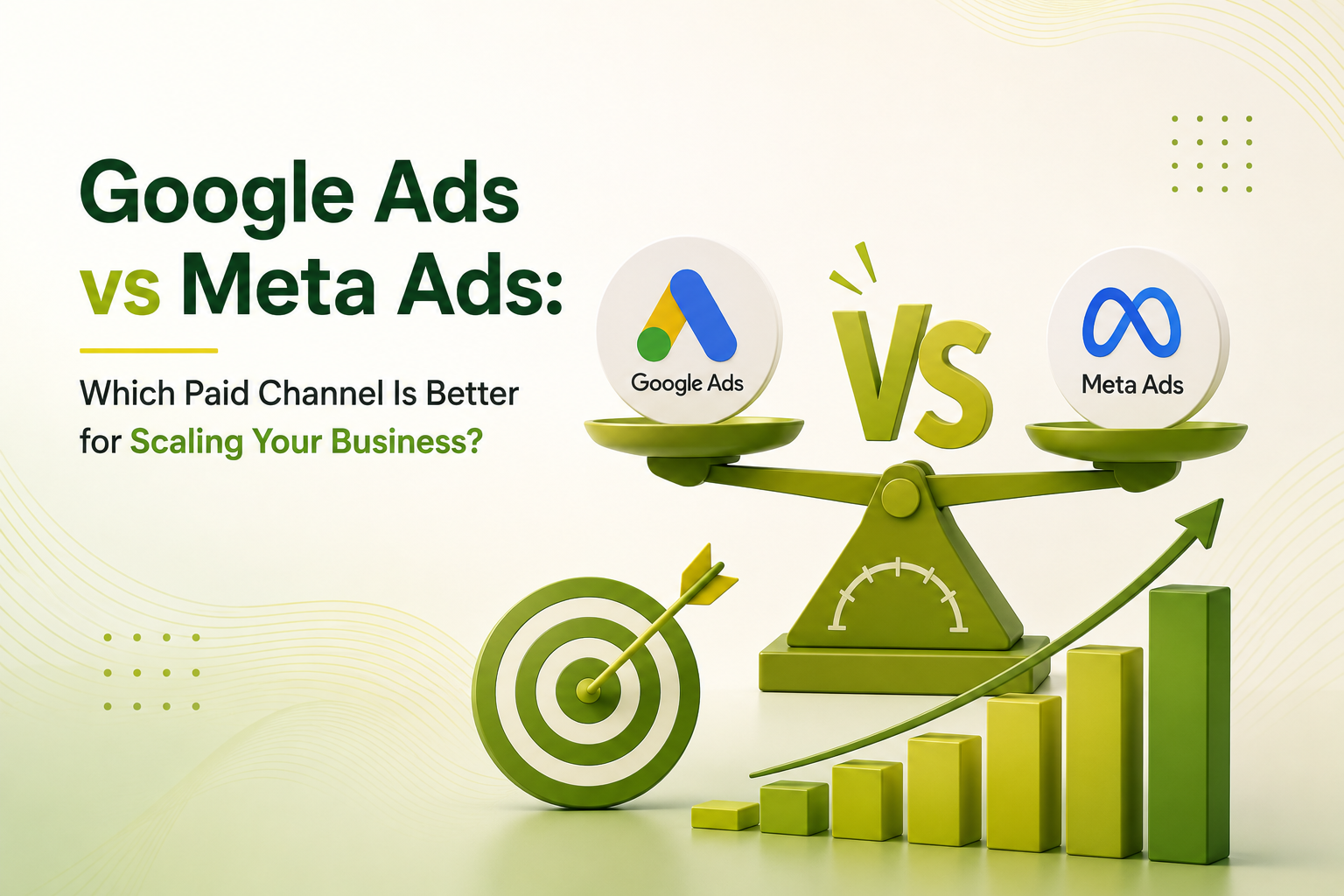
Google Ads vs Meta Ads: Which Paid Channel Is Better for Scaling Your Business?
When businesses want to accelerate growth, paid advertising is often one of the fastest ways to reach potential customers. Two of the most widely used platforms are Google Ads and Meta Ads.
But which one is better for scaling your business?
The answer is not as simple as choosing one platform over the other. Google Ads and Meta Ads work differently, target users at different stages of the buying journey and require different approaches to campaign management.
Google Ads is particularly powerful for capturing existing demand when people are actively searching for a product or service. Meta Ads, which includes advertising across Facebook and Instagram, is highly effective for creating demand, reaching specific audiences and building product awareness.
For many businesses, the strongest strategy is not Google Ads versu Meta Ads, but understanding how to use both channels together.
What Is the Difference Between Google Ads and Meta Ads?
The biggest difference is user intent.
Google Ads primarily captures demand that already exists. Someone searches for a product, service or solution, and relevant advertisements can appear alongside the search results.
Meta Ads works differently. Instead of waiting for someone to search, businesses can proactively introduce products and services to audiences based on factors such as interests, demographics, behaviours and interactions.
In simple terms:
Google Ads = Capture existing demand
Meta Ads = Create and influence demand**
Understanding this difference is essential when deciding where to invest your advertising budget.
How Google Ads Works
Google Ads allows businesses to advertise across Google’s search and broader advertising ecosystem.
Search campaigns are particularly valuable because they reach users when they are actively looking for something.
For example, someone searching for:
* “performance marketing agency”
* “Shopify development company”
* “best accounting software”
* “buy running shoes online”
already has some level of intent.
A relevant Google Ad can place the business in front of that potential customer at the right moment.
Advantages of Google Ads
Google Ads can be effective because it allows businesses to:
* Target high-intent search queries
* Reach customers actively looking for solutions
* Control advertising budgets
* Target specific locations
* Measure conversions
* Test different keywords and messages
* Scale campaigns based on performance
For businesses with strong search demand, Google Ads can be an important customer acquisition channel.
How Meta Ads Works
Meta Ads enables businesses to advertise across platforms such as Facebook and Instagram.
Rather than relying primarily on search intent, Meta uses audience and behavioural signals to help advertisers reach relevant users.
For example, an ecommerce brand selling skincare products can show visually engaging advertisements to audiences that are likely to be interested in beauty, skincare or related products.
Meta Ads can be especially useful for products that benefit from visual presentation and storytelling.
Advantages of Meta Ads
Meta Ads can help businesses:
* Reach new audiences
* Build product awareness
* Create demand
* Use visual advertising formats
* Retarget website visitors
* Promote offers and products
* Test multiple creative concepts
* Build remarketing audiences
This makes Meta particularly useful for D2C, ecommerce, lifestyle and visually driven brands.
When Should You Choose Google Ads?
Google Ads can be a strong choice when customers are already searching for what your business offers.
It can work particularly well for:
Service-Based Businesses
Businesses offering services such as web development, SEO, legal services, financial services or professional consulting can benefit from capturing searches from people actively looking for providers.
B2B Businesses
B2B companies can use Google Search campaigns to reach people searching for specific software, services or business solutions.
For example, someone searching for “CRM software for small business” has a clear problem and may be actively evaluating solutions.
Local Businesses
Google Ads can help businesses target customers searching for local services or products.
High-Intent Ecommerce
Google Shopping and search campaigns can help ecommerce businesses reach customers who are already researching or looking to purchase specific products.
When Should You Choose Meta Ads?
Meta Ads can be particularly valuable when businesses need to introduce products to new audiences.
It can work well for:
D2C Brands
Consumer brands can use visual creative to demonstrate products, communicate benefits and build emotional connections.
Ecommerce Businesses
Meta’s visual formats can be effective for showcasing products, promotions, new launches and customer experiences.
New Products
If customers are not actively searching for a new product category, Meta can help create awareness and generate interest.
Brands with Strong Creative Assets
Businesses with high-quality images, videos, customer testimonials and engaging content can take advantage of Meta’s creative-first environment.
Which Platform Is Better for Ecommerce?
Both Google Ads and Meta Ads can play important roles in ecommerce growth.
Google can capture users who are already searching for specific products.
Meta can introduce products to people who may not have been actively searching but could still be interested.
Consider a customer looking for running shoes.
They might first see a running shoe video on Instagram, visit the website and leave without purchasing.
Later, they might search Google for the brand name or product and complete the purchase.
In this scenario, both platforms contribute to the customer journey.
This is why businesses should avoid evaluating channels only on the last click.
Which Platform Is Better for B2B?
For many B2B businesses, Google Ads can be particularly useful for capturing high-intent searches.
Someone searching for a specific business solution may already understand their problem and be actively evaluating vendors.
However, Meta Ads can still contribute to B2B growth through:
* Brand awareness
* Remarketing
* Content promotion
* Audience building
* Thought leadership
* Lead generation
Depending on the target audience, LinkedIn Ads may also be worth considering alongside Google and Meta.
The most effective channel mix depends on the company’s sales cycle, customer profile and average customer value.
# Google Ads vs Meta Ads: What About Cost?
Advertising costs vary significantly based on industry, audience, competition, geography, campaign objective and creative quality.
It is therefore difficult to say that Google Ads is always cheaper than Meta Ads or vice versa.
Instead of asking:
Which platform has the lowest CPC?“
businesses should ask:
“Which platform generates customers at a profitable acquisition cost?”
For example, a campaign with a higher cost per click may still be more profitable if it produces more qualified leads or customers.
Important metrics include:
* Cost per click
* Conversion rate
* Cost per lead
* Customer acquisition cost
* Return on ad spend
* Average order value
* Customer lifetime value
* Revenue generated
The focus should always be on business outcomes rather than surface-level metrics.
Why Creative Matters More on Meta
One of the biggest differences between Google Ads and Meta Ads is the role of creative.
On Google Search, the user has already expressed intent through a search query. The advertisement needs to communicate relevance and value quickly.
On Meta, the advertisement often needs to interrupt the user’s browsing experience and earn their attention.
This makes creative testing extremely important.
Businesses can test:
* Short-form videos
* Product demonstrations
* Customer testimonials
* Before-and-after content
* User-generated content
* Static images
* Carousels
* Different headlines
* Different offers
Strong creative can significantly influence campaign performance.
Why Keywords Matter More on Google
Google Search campaigns rely heavily on understanding what users are searching for.
Businesses need to identify relevant keywords based on:
* Search intent
* Commercial value
* Competition
* Search volume
* Customer needs
Keyword research should go beyond simply finding popular terms.
For example:
**”digital marketing”**
may have broad intent.
Whereas:
“performance marketing agency for ecommerce
can indicate much stronger commercial intent.
Understanding search intent helps businesses allocate their advertising budget more effectively.
Can You Use Google Ads and Meta Ads Together?
Yes. In many cases, using both platforms can create a stronger full-funnel marketing strategy.
For example:
**Meta Ads → Awareness → Website Visit → Remarketing → Google Search → Conversion → Email/CRM → Repeat Purchase**
Meta can introduce your brand to new audiences.
Google can capture people who later search for your brand, product or service.
Remarketing can bring back visitors who did not convert.
Email and CRM campaigns can continue nurturing existing customers or leads.
This creates a connected customer journey instead of treating each advertising platform as an isolated channel.
How to Decide Where to Spend Your Budget
Before allocating your advertising budget, consider five important factors.
1. Customer Intent
Are people already searching for your product or service?
If yes, Google Ads may be a strong starting point.
If demand needs to be created, Meta Ads may offer greater opportunities.
2. Product Type
Visually appealing consumer products can perform well on Meta.
Products and services that customers actively search for can benefit from Google.
3. Sales Cycle
Businesses with short buying journeys may see faster results from paid advertising.
Businesses with longer B2B sales cycles may need campaigns that combine awareness, lead generation, remarketing and nurturing.
4. Creative Resources
Meta generally requires a consistent flow of high-quality creative assets.
Google Search relies more heavily on keyword strategy, ad messaging and landing page relevance.
5. Customer Acquisition Economics
Always compare advertising performance with your customer acquisition cost and customer lifetime value.
A channel that generates inexpensive leads but poor-quality customers may not be the best channel for growth.
How to Scale Paid Advertising Successfully
Scaling does not simply mean increasing your daily advertising budget.
Before scaling, businesses should establish a strong foundation.
Step 1: Define Your Goals
Set measurable objectives for leads, revenue, customers or sales.
Step 2: Identify Your Best Audience
Understand who your highest-value customers are and what motivates them to buy.
Step 3: Build High-Converting Landing Pages
Make sure your website can turn paid traffic into meaningful actions.
Step 4: Track Conversions Properly
Implement reliable analytics and conversion tracking to understand campaign performance.
Step 5: Test Campaigns
Experiment with audiences, keywords, creatives, offers and landing pages.
Step 6: Identify Winning Campaigns
Determine which campaigns consistently produce profitable results.
Step 7: Scale Gradually
Increase investment in successful campaigns while monitoring acquisition costs and conversion rates.
Step 8: Continue Optimising
Scaling should never mean stopping optimisation. Performance needs to be reviewed continuously.
Common Mistakes Businesses Make
Choosing a Platform Based Only on Popularity
A platform may be popular but still be unsuitable for your target audience.
Focusing on Clicks Instead of Revenue
Clicks are not the final goal. Customers and revenue are.
Sending All Traffic to the Homepage
Dedicated landing pages are often better suited to specific advertising campaigns.
Running the Same Creative for Too Long
Audience fatigue can reduce campaign performance, particularly on social platforms.
Scaling Before Tracking Is Ready
If conversion tracking is inaccurate, increasing spend can make it difficult to understand whether growth is actually profitable.
Ignoring Retargeting
Many users do not convert during their first interaction with a brand. Retargeting can help bring them back into the customer journey.
The Bottom Line: Google Ads or Meta Ads?
So, which paid channel is better for scaling your business?
There is no universal winner.
Google Ads is often stronger when you want to capture existing demand and reach users with high purchase intent.
Meta Ads can be particularly powerful when you want to build awareness, create demand and reach new audiences through engaging creative.
For many businesses, the best approach is to use both strategically.
The right strategy could look like:
Google Ads for high-intent demand + Meta Ads for audience growth + SEO for organic visibility + Retargeting for conversion + CRM and automation for retention.
When these channels work together, businesses can build a more predictable and scalable customer acquisition system.
Final Thoughts
Choosing between Google Ads and Meta Ads should not be based on which platform is “better” in general. It should be based on **where your customers are, how they search, how they make purchasing decisions and what your business needs to achieve.
The most successful performance marketing strategies combine the right channels with strong creative, accurate tracking, conversion-focused websites and continuous optimisation.
Whether you are a D2C brand looking to increase ecommerce sales or a B2B company trying to generate qualified leads, the goal should remain the same: turn your advertising investment into measurable, sustainable business growth.