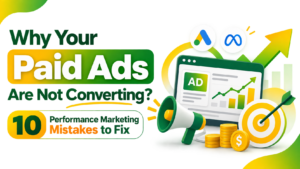
Paid advertising can be one of the fastest ways to generate traffic, leads, and sales. But simply launching a Google Ads or Meta Ads campaign does not guarantee results.
Many businesses spend money on paid advertising and see clicks, impressions, and website visits, yet struggle to generate enough conversions. When this happens, the problem is not always the advertising platform. It could be the targeting, messaging, landing page, offer, tracking, or the overall customer journey.
The good news is that most paid advertising problems can be identified and improved with the right approach.
In this guide, we explore 10 common performance marketing mistakes that can prevent paid ads from converting and explain what businesses can do to fix them.
1. Targeting the Wrong Audience
One of the biggest reasons paid ads fail to convert is poor audience targeting.
Your campaign may generate thousands of impressions and clicks, but if the people seeing your ads are not interested in your product or service, those clicks are unlikely to become customers.
For example, a premium B2B software company targeting a broad consumer audience may generate website traffic but very few qualified leads.
How to fix it
Start by defining your ideal customer.
Consider:
* Who is most likely to buy?
* What problem are they trying to solve?
* What industry or market are they in?
* What keywords do they search for?
* What products or services have they previously interacted with?
* What objections might prevent them from purchasing?
For Google Ads, focus on relevant keywords and search intent. For Meta Ads, use appropriate audience signals, customer data, interests, behaviours, and retargeting audiences where relevant.
The goal is not to reach the largest possible audience. It is to reach the most relevant audience.
2. Using the Wrong Search Intent
For search advertising, keywords alone are not enough. You need to understand the intent behind those keywords.
Consider these searches:
* “What is CRM software?”
* “Best CRM software for small businesses”
* “CRM software pricing”
* “Buy CRM software”
Each search suggests a different stage of the buying journey.
If your campaign treats every search as equally valuable, your budget may be spent on users who are researching rather than ready to take action.
How to fix it
Group keywords according to search intent, such as:
* Informational
* Commercial
* Transactional
* Navigational
Then create ad copy and landing pages that match the user’s intent.
Someone looking to buy should not be sent to a generic educational page. Someone researching a problem may need helpful content before they are ready to convert.
Better intent matching can lead to more relevant traffic and stronger conversion performance.
3. Your Ad Copy Is Not Connecting With the Customer
Your advertisement has a limited amount of space to convince someone to click.
If your messaging focuses only on what your company does instead of what the customer gains, your ads may struggle to stand out.
For example:
Weak message:
“We provide digital marketing services for businesses
Stronger message:
“Generate More Qualified Leads With Data-Driven Performance Marketing.”
The second version focuses more clearly on the potential customer outcome.
How to fix it
Your ad copy should communicate:
* The customer’s problem
* Your solution
* A key benefit
* A differentiator
* Relevant proof or trust signals where appropriate
Test different messaging instead of assuming that your first version will be the best performer.
4. Your Landing Page Does Not Match Your Ad
Imagine clicking an ad for “Shopify Development Services” and arriving on a homepage that talks about every service the company offers.
The visitor now has to search for the information they were promised.
That creates friction.
A strong paid advertising campaign should create a consistent journey:
Ad → Landing Page → Offer → Conversion
If the ad promises one thing but the landing page communicates something completely different, users may leave without taking action.
How to fix it
Create landing pages that closely match the campaign.
For example:
Ad: Shopify Development Services
Landing Page: Shopify Development Services
CTA: Request a Shopify Development Consultation
Keep the message, offer, keywords, and user intent aligned across the journey.
5. Your Website Is Not Optimised for Conversions
Sometimes the advertising campaign is working, but the website is preventing conversions.
You may be generating relevant traffic, but visitors could leave because the website is:
* Slow
* Difficult to navigate
* Not mobile-friendly
* Confusing
* Missing trust signals
* Lacking clear calls to action
* Too complicated
* Poorly designed
* Missing important product or service information
Before increasing your advertising budget, review your website experience.
How to fix it
Focus on conversion rate optimisation (CRO).
Test improvements to:
* Headlines
* Product pages
* Landing pages
* Forms
* Calls to action
* Page layouts
* Navigation
* Reviews and testimonials
* Trust badges
* Pricing information
* Checkout experience
Getting more value from your existing traffic can often be more efficient than simply buying more traffic.
6. You Are Sending Traffic to the Homepage
Your homepage is designed to introduce your business, not necessarily convert every type of paid visitor.
Sending all paid traffic to your homepage can make the customer journey less relevant.
For example, if someone clicks an ad for “accounting software for small businesses”, sending them to a homepage containing information about multiple software products and services may create unnecessary friction.
How to fix it
Create dedicated landing pages for specific campaigns, products, services, and audiences.
A landing page should answer three important questions quickly:
**What is this?
**Why should I care?
**What should I do next?
The clearer the journey, the easier it is for visitors to take action.
7. Your Offer Is Not Strong Enough
Sometimes people understand your product and trust your business but still do not convert.
The problem may be the offer.
A customer may think:
* Is this worth the price?
* Why should I choose this brand?
* What do I get?
* Is there a better alternative?
* Is there any reason to act now?
If the perceived value is not strong enough, advertising alone cannot solve the problem.
How to fix it
Review your value proposition.
Depending on your business model, your offer could include:
* Free consultation
* Product trial
* Free assessment
* Limited-time promotion
* Bundle pricing
* Free delivery
* Bonus service
* Money-back guarantee
* Flexible payment options
* Exclusive benefits
The objective is not to discount everything. It is to make the **value of taking action clear**.
8. You Are Not Retargeting Interested Visitors
Not everyone converts during their first visit.
A customer might:
* Visit a product page
* Read your service information
* Add an item to their cart
* Start filling out a form
* Compare your offer with competitors
* Leave the website
If you only focus on acquiring new visitors, you may miss opportunities to bring interested users back.
How to fix it
Build retargeting campaigns around user behaviour.
For example:
Product viewed → No purchase → Retargeting ad → Product page → Purchase
You can also create different audiences based on actions they have taken.
For example:
* Website visitors
* Product viewers
* Cart abandoners
* Previous customers
* Lead form visitors
* Engaged social media users
The messaging should reflect where the user is in the customer journey rather than showing everyone the same advertisement.
9. Your Tracking and Analytics Are Incorrect
You cannot optimise what you cannot measure accurately.
If conversion tracking is incorrectly configured, you may believe a campaign is failing when it is actually generating valuable results—or continue investing in a campaign that is not profitable.
Common tracking problems include:
* Incorrect conversion events
* Duplicate conversions
* Missing purchase values
* Poor UTM tracking
* Incorrect attribution
* Broken analytics implementation
* Untracked phone calls or form submissions
How to fix it
Make sure important conversion events are properly tracked.
Depending on the business, these may include:
* Purchases
* Lead submissions
* Calls
* Sign-ups
* Demo bookings
* Downloads
* Add-to-cart actions
* Checkout starts
Go beyond tracking clicks. Connect advertising data with website analytics and CRM or sales data where possible.
This helps you understand whether campaigns are generating real business outcomes, not just platform-level metrics.
10. You Are Scaling Before You Have a Winning Campaign
A common mistake is increasing the budget simply because a campaign is generating conversions.
But not every conversion is equally valuable.
A campaign may produce sales while still having:
* High customer acquisition costs
* Low average order value
* Poor-quality leads
* Low customer lifetime value
* Weak profit margins
Scaling too quickly can make these problems worse.
How to fix it
Before increasing spend significantly, evaluate:
* Conversion rate
* Cost per conversion
* Customer acquisition cost
* ROAS
* Revenue
* Average order value
* Lead quality
* Customer lifetime value
* Profitability
Once you identify a campaign that consistently produces valuable customers, scale gradually and continue monitoring performance.
Paid Ads Need More Than a Good Advertisement
Successful performance marketing is not just about creating an attractive ad.
It is about building a connected customer journey.
Think of the process as:
**Right Audience → Right Message → Right Offer → Right Landing Page → Smooth Conversion → Accurate Tracking → Continuous Optimisation
If one part of this process is weak, overall performance can suffer.
For example, a business could have excellent targeting but poor landing pages. Another company could have a strong website but target the wrong audience. A third business could generate sales but fail to track revenue correctly.
The solution is to look at the complete system.
A Better Performance Marketing Optimisation Process
A structured optimisation process can help businesses improve campaigns consistently.
Step 1: Analyse the Data
Look at campaign, website, conversion, and sales data to identify where users are dropping out.
Step 2: Identify the Biggest Problem
Do not change ten things at once. Find the stage creating the biggest performance gap.
Step 3: Create a Hypothesis
For example:
“Our landing page may have a low conversion rate because the offer and CTA are not clear enough.”*
Step 4: Test the Change
Test different headlines, creatives, audiences, offers, landing pages, or calls to action.
Step 5: Measure the Result
Compare performance using meaningful metrics rather than relying only on clicks or impressions.
Step 6: Scale Successful Changes
Once a change consistently improves performance, implement it more widely and continue testing.
The Most Important Metrics to Monitor
The right metrics depend on your business model, but performance marketers should generally look beyond surface-level engagement.
Click-Through Rate (CTR)
Shows how effectively your ad attracts clicks.
Conversion Rate
Shows the percentage of visitors who complete the desired action.
Cost Per Acquisition (CPA)
Shows how much you spend to acquire a customer or conversion.
Customer Acquisition Cost (CAC)
Measures the broader cost of acquiring a customer.
Return on Ad Spend (ROAS)
Shows how much revenue is generated relative to advertising spend.
Average Order Value (AOV)
Important for ecommerce businesses because higher order values can improve campaign economics.
Customer Lifetime Value (CLV)
Helps businesses understand the long-term value of acquired customers rather than focusing only on the first purchase.
Lead Quality
For B2B businesses, generating more leads is not enough. The quality and revenue potential of those leads matter.
Final Thoughts
When paid ads are not converting, the answer is rarely as simple as the ads do not work.
The real issue could be audience targeting, search intent, messaging, landing pages, website experience, offer, retargeting, tracking, or scaling too quickly.
The best performance marketing strategies focus on the entire customer journey rather than one advertising platform or campaign.
Instead of asking:
“How can we get more clicks?”
Ask:
“How can we turn more of the right visitors into valuable customers?
That shift changes how you approach paid advertising.
With accurate data, relevant targeting, compelling messaging, strong landing pages, effective conversion journeys, and continuous optimisation, paid advertising can become a predictable growth channel rather than an unpredictable expense.
The goal is not simply to spend more on ads. **The goal is to make every marketing investment work harder and contribute to measurable business growth.